
NBA Finals Spotlight Builds as Spurs and Knicks Prepare for Championship Clash
By Dominic Chase |
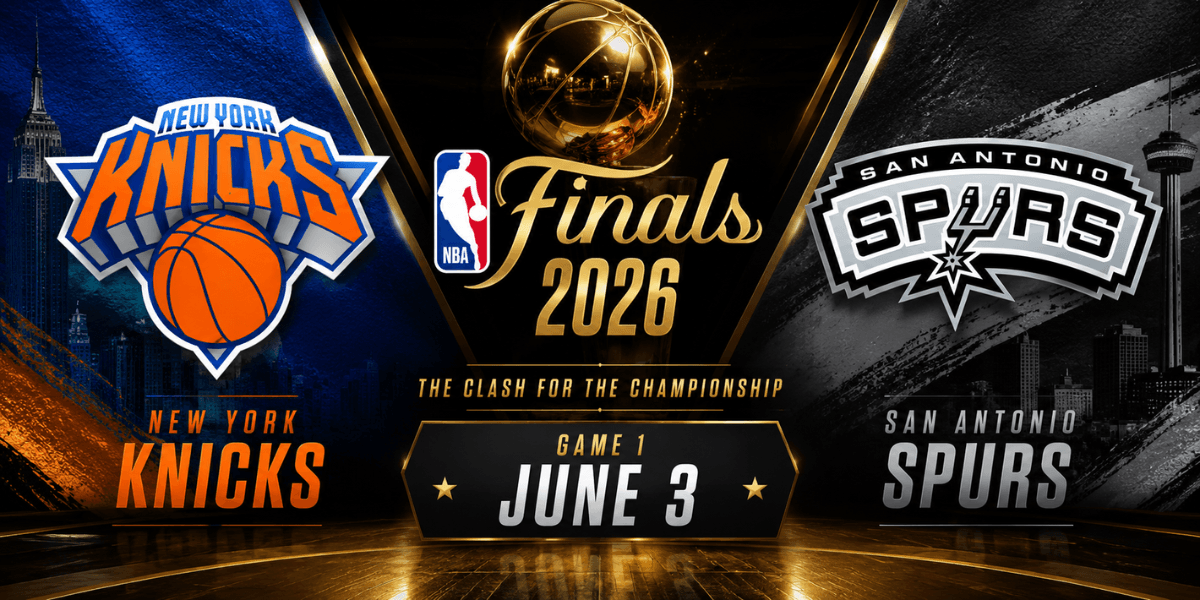
The NBA postseason reaches its defining stage as the San Antonio Spurs and New York Knicks prepare for a highly anticipated championship series that brings together two franchises on dramatically different trajectories. The matchup has drawn widespread attention not only for its competitive potential but also for the contrasting team-building philosophies that have shaped each roster’s rise to this moment.
San Antonio enters the series as one of the league’s most intriguing young contenders, built around a core that blends emerging talent with disciplined system basketball. At the center of that transformation is Victor Wembanyama, whose defensive range and offensive versatility have redefined how opposing teams construct their game plans. His ability to protect the rim while also stretching the floor has allowed the Spurs to maintain one of the most adaptive defensive schemes in the postseason. Beyond individual performance, the Spurs’ identity has been strengthened by improved ball movement, rapid transition execution, and a commitment to exploiting mismatches across multiple positions.
Their playoff run has also highlighted the coaching staff’s willingness to adjust in real time. Rather than relying on a single offensive structure, San Antonio has alternated between pace-heavy lineups and slower, half-court-oriented sets depending on matchup demands. This flexibility has been particularly effective in close series situations, where late-game execution and defensive stops have proven decisive. The Spurs’ bench depth has also played a key role, providing energy and stability when starters rest and ensuring minimal drop-off in intensity.
On the other side, the New York Knicks arrive with a different kind of momentum, grounded in physicality, structure, and half-court precision. Their postseason success has been driven by guard play that prioritizes decision-making under pressure, with Jalen Brunson serving as the central engine of their offense. Brunson’s leadership in pick-and-roll situations has consistently created scoring opportunities, while his composure in late-game scenarios has helped New York close out tightly contested matchups.
The Knicks’ supporting cast has complemented this approach with disciplined defense and timely scoring contributions. Their ability to control tempo and limit turnovers has been a defining factor throughout the playoffs. Unlike more fast-paced teams, New York thrives in structured possessions where defensive positioning and shot selection dictate outcomes. This methodical approach has allowed them to neutralize more athletic opponents and dictate the rhythm of games.
The upcoming series presents a compelling tactical contrast. San Antonio’s preference for transition basketball and spacing-oriented offense will be tested against New York’s deliberate pace and physical perimeter defense. One of the key strategic questions will be whether the Spurs can accelerate the game without sacrificing efficiency, or whether the Knicks can slow possessions enough to force contested mid-range opportunities and reduce open-floor scoring chances.
Rebounding is expected to be another critical battleground. The Spurs have excelled in generating second-chance opportunities through long rebounds and aggressive positioning, while the Knicks have emphasized collective boxing out and limiting opponents to single-shot possessions. Whichever team gains control of the glass may significantly influence the overall tempo and scoring distribution of the series.
Defensively, both teams bring distinct strengths. San Antonio relies heavily on length and switching capabilities to disrupt passing lanes and protect the paint. Their defensive rotations are designed to funnel opponents into difficult perimeter shots, relying on recovery speed and shot contesting to close possessions. The Knicks, by contrast, emphasize structured defensive assignments, physical on-ball pressure, and coordinated help defense that forces turnovers and disrupts offensive rhythm.
Off the court, anticipation continues to grow as fans and analysts debate how the series will unfold. The matchup represents more than just a championship opportunity; it also symbolizes a potential shift in the league’s competitive balance. A Spurs victory would signal the arrival of a new powerhouse built around youth and versatility, while a Knicks championship would mark a long-awaited return to prominence for one of basketball’s most storied franchises.
As preparation intensifies, both teams are expected to focus heavily on film study, situational execution, and rotation refinement. Coaches will be tasked with identifying subtle advantages, whether through defensive matchups, bench utilization, or late-game play-calling, that could ultimately determine the outcome of the series.
With both franchises entering the stage at near-peak form, the championship matchup stands as a defining moment in the season, shaped by contrasting styles, emerging stars, and the pursuit of a title that carries significant historical weight for both organizations.

PrimeTime Press Contributor
Dominic Chase
Covers breaking news and sport, following stories as they develop and the people at the centre of them.
This article features partner, contributor, or branded content from a third party. Members of the PrimeTime Press editorial staff were not involved in the creation of this content. All views and opinions are those of the contributor alone.