
Why More Readers Are Looking To History For Answers
By Dominic Chase |
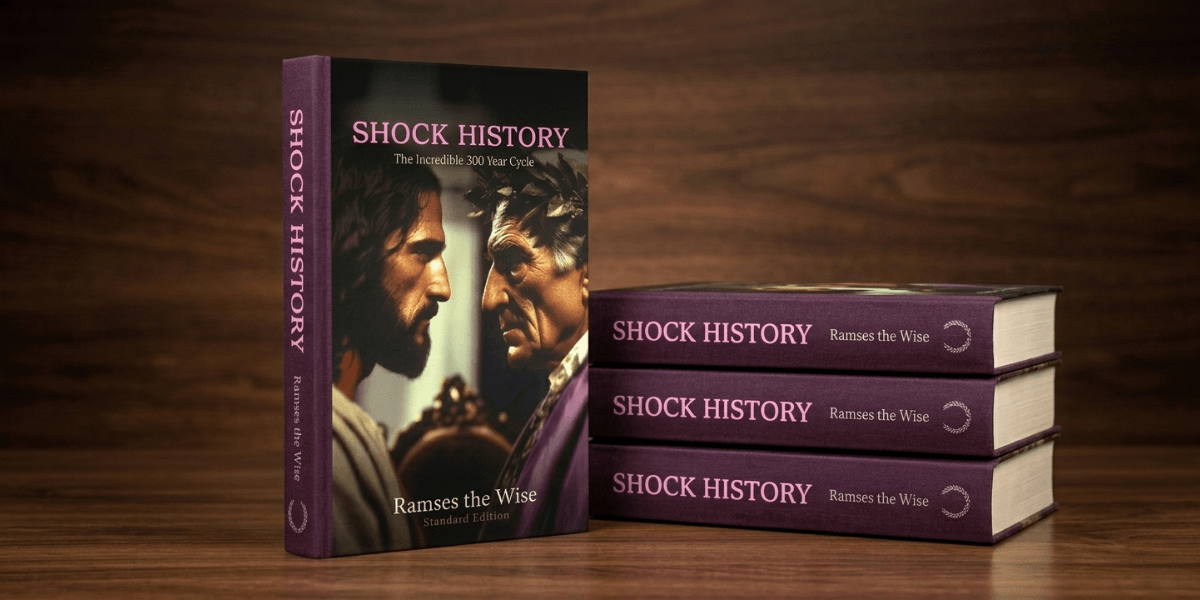
Shock History explores 3,500 years of recurring historical patterns, offering a new framework for understanding today’s global challenges.
Every generation believes it is living through unprecedented times.
Political divisions deepen. Economic uncertainty rises. New technologies transform daily life. Global power structures shift. Social norms evolve. Headlines announce developments that appear unlike anything that has come before.
Yet when people step back and look beyond the immediate moment, an interesting question begins to emerge.
How much of what feels unprecedented is actually part of a much older story?
That question lies at the center of Shock History: The Incredible 300 Year Cycle, a work that challenges readers to examine the past through a different lens. Rather than viewing history as a collection of isolated events, the book proposes that many of the most significant developments in human civilization follow recurring patterns that can be observed across centuries.
The idea is both ambitious and provocative.
If history contains recognizable cycles, then understanding those cycles may offer valuable insight into the forces shaping the present day.
For readers seeking context in an increasingly complex world, that possibility has become increasingly compelling.
The Search For Meaning In Uncertain Times
Periods of rapid change often create a desire for perspective.
When societies face uncertainty, people naturally search for frameworks that help explain what they are experiencing. Historians, economists, political analysts, and researchers all attempt to identify patterns that connect the present to the past.
Shock History enters this conversation with a unique perspective.
Instead of focusing solely on individual historical events, the book examines long term patterns spanning more than 3,500 years of recorded human history. Its central argument suggests that major societal transformations frequently occur within recurring cycles rather than as entirely independent events.
This approach encourages readers to move beyond daily headlines and consider broader historical movements.
Rather than asking only what is happening, the book asks whether similar developments have occurred before and whether recurring patterns can help explain them.
History As A Cycle Rather Than A Straight Line
Traditional historical narratives often follow a linear structure.
One event leads to another. One era replaces the previous one. Progress moves forward over time.
Shock History proposes an alternative perspective.
The book explores the possibility that civilizations experience recurring phases of growth, disruption, adaptation, and transformation. While the specific details may differ from one era to another, the underlying patterns often appear remarkably familiar.
Political instability. Economic realignment. Technological disruption. Cultural change.
These themes emerge repeatedly throughout history, even when separated by centuries.
By highlighting these similarities, Shock History encourages readers to view history not as a straight line, but as a series of interconnected cycles.
This perspective does not suggest that events repeat exactly. Instead, it raises the possibility that human societies may respond to recurring challenges in ways that create recognizable historical rhythms.
The Fascination With Patterns
Human beings have always been drawn to patterns.
Patterns provide structure. They help explain complexity. They transform seemingly disconnected events into narratives that feel understandable.
This fascination is evident across countless disciplines, from science and economics to psychology and philosophy.
History is no exception.
For centuries, scholars have debated whether civilizations rise and fall according to identifiable cycles. Some have argued that human behavior remains remarkably consistent across generations, leading societies to encounter similar challenges regardless of time or place.
Shock History builds upon this tradition of inquiry.
The book does not present history as predetermined. Rather, it invites readers to explore whether recurring historical themes offer clues about the forces shaping societies across generations.
For many readers, that exploration becomes as intriguing as the conclusions themselves.
A Different Way To Read The Present
One reason historical cycles continue to attract interest is their potential relevance to contemporary events.
People often look to history not merely to understand the past, but to better interpret the present.
When economic systems change, political movements emerge, or technological breakthroughs reshape society, historical context becomes invaluable. Similar developments may have occurred before, offering lessons about how societies responded and adapted.
Shock History encourages readers to approach current events with this broader perspective.
The book suggests that understanding long term patterns can help illuminate the larger forces operating beneath the surface of daily news.
Whether examining political shifts, economic transformations, or cultural developments, the framework encourages readers to think across decades and centuries rather than focusing exclusively on immediate events.
That broader perspective can be both challenging and enlightening.
More Than Historical Analysis
What distinguishes Shock History from many traditional history books is its emphasis on interpretation.
The work is not simply a collection of historical facts or timelines. Instead, it presents a framework through which readers can connect events across vast periods of time.
This approach appeals to individuals who enjoy asking larger questions.
Why do civilizations change?
What forces drive societal transformation?
Do certain patterns consistently emerge throughout human history?
Can studying those patterns improve our understanding of the present?
These are the questions that drive the book’s exploration.
As the author writes, “History doesn’t just repeat itself. It follows patterns we can learn to recognize.”
Whether readers fully embrace that idea or simply find it thought provoking, the book encourages a deeper engagement with history itself.
A Conversation That Continues Across Generations
The debate over historical cycles is unlikely to disappear.
For as long as people have studied the past, they have searched for recurring themes that might explain the rise and fall of societies. Every generation revisits these questions through its own experiences and challenges.
Shock History contributes to that ongoing conversation by presenting a comprehensive examination of recurring historical patterns across more than three millennia.
Its value lies not only in the answers it proposes, but also in the questions it encourages readers to ask.
In a world increasingly defined by rapid change, those questions may be more relevant than ever.
Understanding history has always been about more than studying the past. It is about understanding ourselves, the societies we create, and the forces that continue to shape the world around us.
Explore Shock History
Readers interested in exploring the ideas behind Shock History: The Incredible 300 Year Cycle can learn more through the book’s official Amazon listing at Shock History: The Incredible 300 Year Cycle.
For updates, historical insights, and ongoing discussions about the patterns that shape societies across generations, follow Shock History on Facebook and subscribe to Ramses The Wise on Youtube.
By examining more than 3,500 years of recorded history, the book offers a thought provoking perspective on one of humanity’s oldest questions: are the events shaping our world truly unique, or are they part of patterns that have been unfolding for centuries?

PrimeTime Press Contributor
Dominic Chase
Covers breaking news and sport, following stories as they develop and the people at the centre of them.
This article features partner, contributor, or branded content from a third party. Members of the PrimeTime Press editorial staff were not involved in the creation of this content. All views and opinions are those of the contributor alone.