
NASA’s New Horizons Spacecraft Successfully Wakes From Hibernation, Preparing for the Next Phase of Deep Space Exploration
By Renee Baptiste |
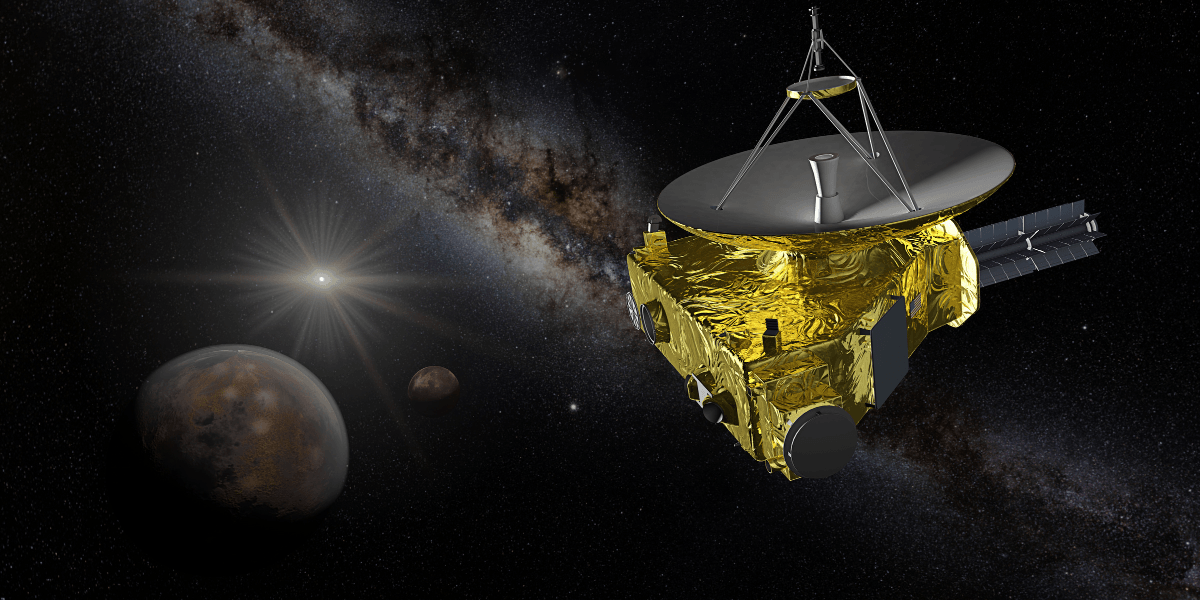
NASA announced on July 7, 2026, that its New Horizons spacecraft has successfully awakened from hibernation in good health, marking another important milestone for one of the agency’s longest-running and most accomplished planetary exploration missions. The successful wake-up confirms that the spacecraft remains fully operational as engineers prepare it for another period of scientific observations in the distant reaches of the solar system.
Launched in January 2006, New Horizons became the first spacecraft to conduct a close flyby of Pluto in 2015, transforming scientific understanding of the dwarf planet and its moons. The mission later made history again by flying past the Kuiper Belt object Arrokoth in 2019, providing humanity’s first close-up observations of one of the most primitive objects ever explored in the solar system. More than twenty years after launch, the spacecraft continues to travel billions of miles from Earth while returning valuable scientific data.
According to NASA, the spacecraft routinely enters hibernation mode during quieter periods of its mission. While in this state, most onboard systems are powered down to conserve energy and reduce wear on critical components. The spacecraft remains capable of monitoring its own health while maintaining communication with mission controllers. When scientific operations or engineering activities are scheduled, controllers transmit commands that bring the spacecraft back to full operational status.
The successful wake-up on July 7 demonstrated that New Horizons responded exactly as expected. Mission engineers confirmed that all major systems were functioning normally after the spacecraft resumed communications with Earth. The health check provides confidence that the spacecraft remains capable of supporting future observations despite operating farther from Earth than nearly every other active NASA mission.
Operating at such extraordinary distances presents unique engineering challenges. Radio signals traveling between Earth and New Horizons require several hours each way because they move at the speed of light across billions of miles. Every command sent to the spacecraft must therefore be carefully planned and tested long before execution. Engineers cannot control the spacecraft in real time, making reliability and autonomous system monitoring essential for mission success.
The New Horizons mission has already reshaped scientific understanding of the outer solar system. Before the Pluto flyby, astronomers viewed Pluto largely as a distant point of light. High-resolution images and scientific measurements revealed an unexpectedly diverse world featuring towering mountains made of water ice, nitrogen glaciers, atmospheric haze layers, and signs of active geological processes. These discoveries challenged long-standing assumptions that small icy bodies at the edge of the solar system would be geologically inactive.
The spacecraft’s encounter with Arrokoth further expanded scientific knowledge. Scientists found that the object likely formed through the gentle merging of two smaller bodies early in the solar system’s history. Because Arrokoth has remained relatively unchanged for billions of years, studying it offers researchers valuable clues about how planets and other celestial bodies formed during the earliest stages of the solar system.
Although New Horizons has completed its primary mission objectives, scientists continue searching for additional opportunities to maximize its scientific value. Instruments aboard the spacecraft can study the space environment of the outer solar system, including charged particles, cosmic dust, and the interaction between the solar wind and interstellar space. These observations complement data collected by other long-running deep space missions and help researchers better understand conditions at the edge of the Sun’s influence.
NASA also noted that the mission continues to contribute to broader scientific research beyond planetary exploration. Measurements gathered by New Horizons can improve models of the heliosphere—the enormous bubble created by the solar wind surrounding the solar system—and may provide insights into how our solar system interacts with interstellar space.
The successful return from hibernation underscores the remarkable durability of spacecraft designed for decades-long missions. Operating reliably after twenty years in the harsh environment of deep space requires careful engineering, extensive testing before launch, and continuous monitoring by mission teams throughout the spacecraft’s lifetime. Each successful wake-up demonstrates the resilience of both the spacecraft and the systems developed to support it.
For the scientific community, every additional year of New Horizons’ operation represents another opportunity to gather unique information from a region of the solar system that remains largely unexplored. Few missions have ventured beyond Pluto, making every observation collected by the spacecraft especially valuable for understanding the structure, history, and evolution of our cosmic neighborhood.
As New Horizons resumes active operations following its latest wake-up, mission specialists will continue evaluating future observation opportunities while ensuring the spacecraft remains healthy for as long as possible. More than two decades after its launch, the mission remains a powerful example of how long-term investment in scientific exploration can continue producing valuable discoveries long after a spacecraft reaches its original destination.

PrimeTime Press Contributor
Renee Baptiste
Covers health, technology, and entertainment, and how each shapes the way audiences live and spend their time.
This article features partner, contributor, or branded content from a third party. Members of the PrimeTime Press editorial staff were not involved in the creation of this content. All views and opinions are those of the contributor alone.